
What Is the NBA Shot Clock? 24-Second Rule Explained
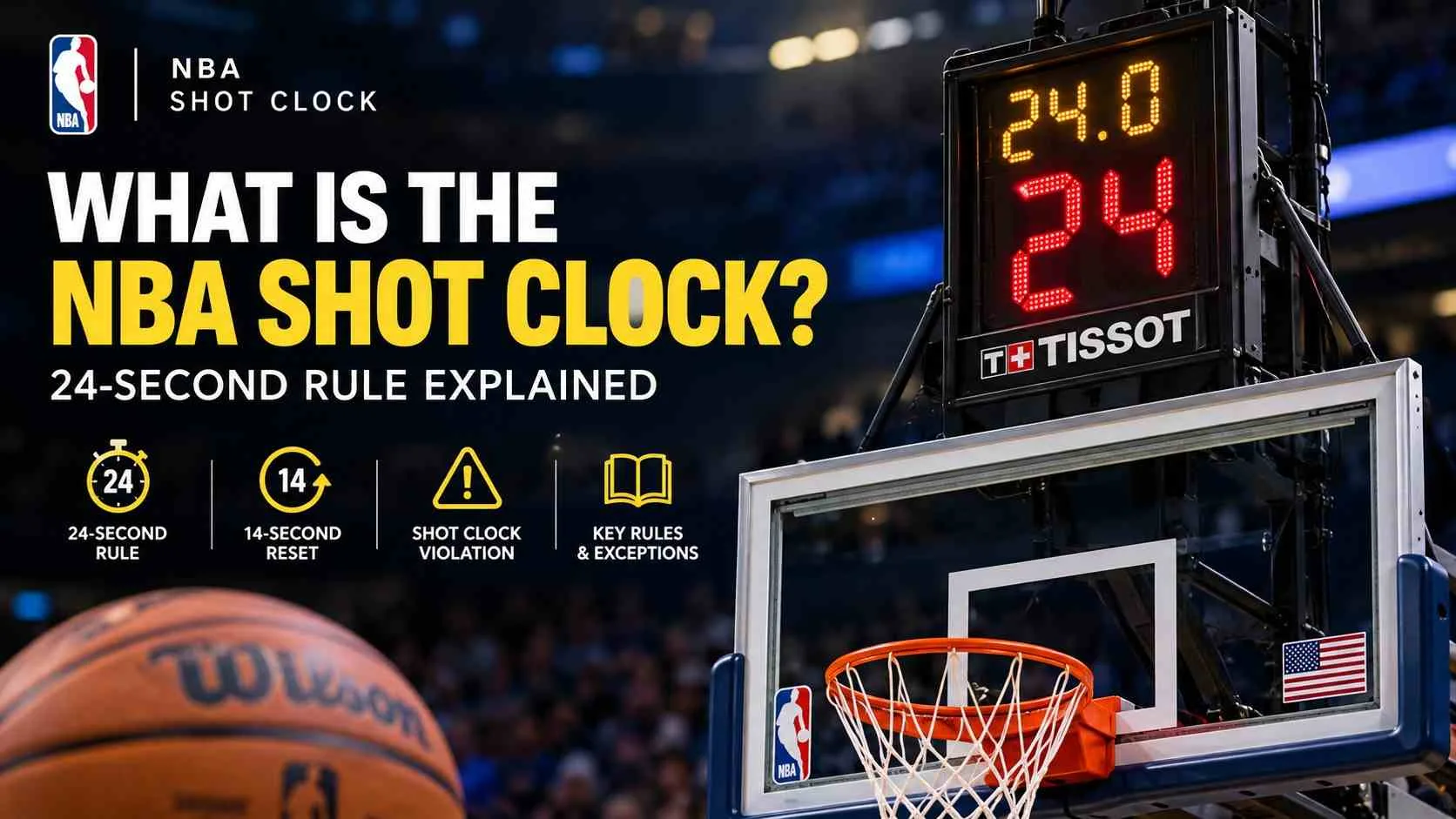
What Is the NBA Shot Clock? 24-Second Rule Explained
BASKETBALL | Rules & Regulations
SOURCE: NBA Official Rulebook; NBA Historical Records
LAST UPDATED: 2026-09-22
READ TIME: 8 min read
DIRECT ANSWER
The NBA shot clock is a 24-second timer that gives a team a limited amount of time to attempt a field goal after gaining possession of the ball. Under NBA Rule No. 7, the clock normally starts at 24 seconds when a team gains new possession.
The shot clock prevents teams from holding the ball indefinitely without attempting to score. When the clock reaches zero, the offensive team must already have released a qualifying field-goal attempt. If it has not, a shot clock violation is called and possession is awarded to the opposing team.
The NBA shot clock does not always reset to 24 seconds. Depending on what happens during a possession, it can reset to 24 seconds, 14 seconds, or remain at the time already showing.
1. How Long Is the NBA Shot Clock?
The standard NBA shot clock is 24 seconds.
Once a team gains possession, it generally has 24 seconds to attempt a field goal. The ball must leave the shooter's hand before the shot clock expires, and the attempt must subsequently make contact with the basket ring under the NBA's shot-clock rule.
NBA Shot Clock Rule at a Glance
| Situation | Shot Clock |
|---|---|
| Standard shot clock | 24 seconds |
| New possession | 24 seconds |
| Qualifying offensive rebound | 14 seconds |
| Shot clock violation | Possession changes |
2. Why Does the NBA Have a 24-Second Shot Clock?
The NBA introduced the 24-second shot clock during the 1954–55 season.
Before the shot clock, teams could slow the game down by holding possession and avoiding shots, particularly when protecting a lead. NBA historical sources credit Syracuse Nationals owner Danny Biasone and general manager Leo Ferris with developing the concept that became the 24-second shot clock.
The rule had a major effect on scoring. NBA historical records note that average team scoring increased from 79.5 points per game to 93.1 points per game after the introduction of the shot clock.
The 24-second clock therefore became one of the defining features of modern professional basketball.
3. How Does the NBA Shot Clock Work?
The basic process is straightforward:
Team gains possession → 24-second clock starts → team attempts a field goal → possession continues or changes.
The clock starts when a team gains new possession of a live ball. On a throw-in, it starts when the ball is legally touched by a player on the court.
A team can use the entire 24 seconds strategically, but it must get the shot off before the clock expires.
Example
Imagine Team A gains possession with 24 seconds showing.
The team passes the ball, dribbles, and creates a scoring opportunity.
At 2 seconds, a player shoots.
If the ball leaves the player's hand before the clock reaches zero, the shot can still count as a legal attempt under the shot-clock rule.
4. What Is a Shot Clock Violation in Basketball?
A shot clock violation occurs when the offensive team fails to make a qualifying field-goal attempt before the shot clock expires.
For a qualifying attempt under the NBA rule, the ball must leave the player's hand before the shot clock expires and then make contact with the basket ring.
When a team commits a shot clock violation, the opposing team is awarded possession.
Simple Example
If the clock reaches:
0.0
and the offensive player has not released the ball, a shot-clock violation occurs.
If the player releases the ball before the expiration, officials determine whether the attempt satisfies the applicable rule.
For more information, see our guide to shot clock violation.
5. What Happens When the NBA Shot Clock Expires?
If a team fails to attempt a qualifying field goal within the allotted time, the NBA calls a shot clock violation.
The ball is then awarded to the defensive team on the sideline near where play was stopped, subject to the NBA's specified inbounding location.
This prevents teams from maintaining possession indefinitely without attempting to score.
6. What Is the NBA 14-Second Shot Clock Rule?
The NBA does not always reset the shot clock to 24 seconds.
In several offensive-rebound situations, the shot clock resets to 14 seconds.
This can happen after an unsuccessful field-goal attempt that contacts the rim when the offensive team regains possession. Similar 14-second provisions apply in certain missed-free-throw and defensive-foul situations specified by NBA Rule No. 7.
The NBA officially adopted the 14-second offensive-rebound reset beginning with the 2018–19 season.
Example
Team A shoots.
The shot hits the rim but misses.
Team A grabs the offensive rebound.
Instead of receiving another full 24 seconds, the shot clock is reset to:
14 seconds
This keeps the game moving while still giving the offense time to create another scoring opportunity.
7. When Does the NBA Shot Clock Reset to 24 Seconds?
Under NBA Rule No. 7, the shot clock resets to 24 seconds in several situations.
These include:
- A change of possession
- Certain backcourt personal fouls
- Certain backcourt violations
- Certain jump-ball situations
- Flagrant fouls
- Punching fouls
The exact reset depends on the circumstances and where the ball will be put into play.
Therefore, the rule is not simply "every foul equals 24 seconds." The location and type of play matter.
8. When Does the Shot Clock Stay the Same?
There are situations where the clock does not automatically return to 24 seconds.
For example, certain defensive fouls in the frontcourt can leave the clock at its current time or reset it to 14 seconds, whichever is greater, depending on the specific situation.
This is one reason NBA shot-clock rules can appear complicated during live games.
The exact result depends on the type of foul, the location of the ball, and the specific provision of Rule No. 7.
9. Does the Shot Clock Reset After an Offensive Rebound?
Usually, a qualifying offensive rebound after a missed field goal that hits the rim results in a 14-second reset.
The rule was changed from 24 seconds to 14 seconds to reduce excessive time following offensive rebounds and keep possessions moving.
However, the reset depends on whether the play satisfies the NBA's specific shot-clock conditions.
10. What Happens If a Shot Does Not Hit the Rim?
This is an important part of the NBA shot-clock rule.
A missed field goal that does not touch the rim does not automatically give the offense a fresh shot clock.
NBA Rule No. 7 specifically lists a field-goal attempt that fails to touch the rim among situations where the shot clock is not reset.
This distinction can become particularly important when officials review a play late in a game.
11. Can the NBA Review a Shot Clock Violation?
Yes.
The NBA's instant-replay rules allow officials to review certain shot-clock situations, including whether the ball was released before the shot clock expired and whether the ball touched the rim when that affects shot-clock administration.
This can be particularly important during the final minutes of close games, where a fraction of a second can affect possession and scoring.
12. Why Is the NBA Shot Clock 24 Seconds?
The 24-second limit was introduced for the 1954–55 NBA season to address slow, low-scoring basketball.
Danny Biasone and Leo Ferris of the Syracuse Nationals developed the concept, and the NBA adopted the 24-second shot clock for the 1954–55 season.
NBA historical material describes the period before the shot clock as one in which teams could stall after gaining a lead. The new rule encouraged teams to attempt shots instead of simply holding possession.
13. How the NBA Shot Clock Changed Basketball
The introduction of the shot clock fundamentally changed how professional basketball was played.
Before it existed, a team with a lead could deliberately slow the game down. With the 24-second limit, teams were required to create scoring opportunities within a defined period.
The NBA's historical review of the 1954–55 season records an immediate increase in average team scoring following the introduction of the rule.
Today, the shot clock influences:
- Offensive strategy
- Defensive pressure
- Fast breaks
- End-of-quarter possessions
- Late-game decisions
- Offensive rebounds
- Timeout strategy
- Last-second shots
The shot clock is therefore not just a timing mechanism; it is a fundamental part of NBA strategy.
14. NBA Shot Clock vs Game Clock
The shot clock and game clock are two different timers.
Game Clock
The game clock measures how much time remains in the quarter or overtime period.
Shot Clock
The shot clock measures how much time the offensive team has to attempt a qualifying field goal.
For example, a team could have:
- 10 seconds left on the game clock
- 8 seconds left on the shot clock
The team has only 8 seconds to attempt its shot because the shot clock expires first.
15. NBA Shot Clock Rules at a Glance
| Situation | Shot Clock |
|---|---|
| New possession | 24 seconds |
| Qualifying offensive rebound | 14 seconds |
| Certain frontcourt defensive situations | Same time or 14 seconds, depending on the rule |
| Certain backcourt fouls or violations | 24 seconds |
| Shot-clock violation | Possession to opponent |
| Missed shot that does not touch the rim | No automatic reset |
The exact application depends on the specific situation under NBA Rule No. 7.
Related Reading
Sources & Verification
Verified against the NBA Official Rulebook and NBA historical records covering the introduction and administration of the shot clock.
Last reviewed: 2026-09-22 by the Laws of Sport Editorial Team.