
The Cylinder Rule in Basketball, Explained Simply
What Is the Cylinder Rule in Basketball?
BASKETBALL | Rules & Regulations
SOURCE: FIBA Official Basketball Rules; NBA Official Rulebook
LAST UPDATED: 2026-09-19
READ TIME: 6 min read
DIRECT ANSWER
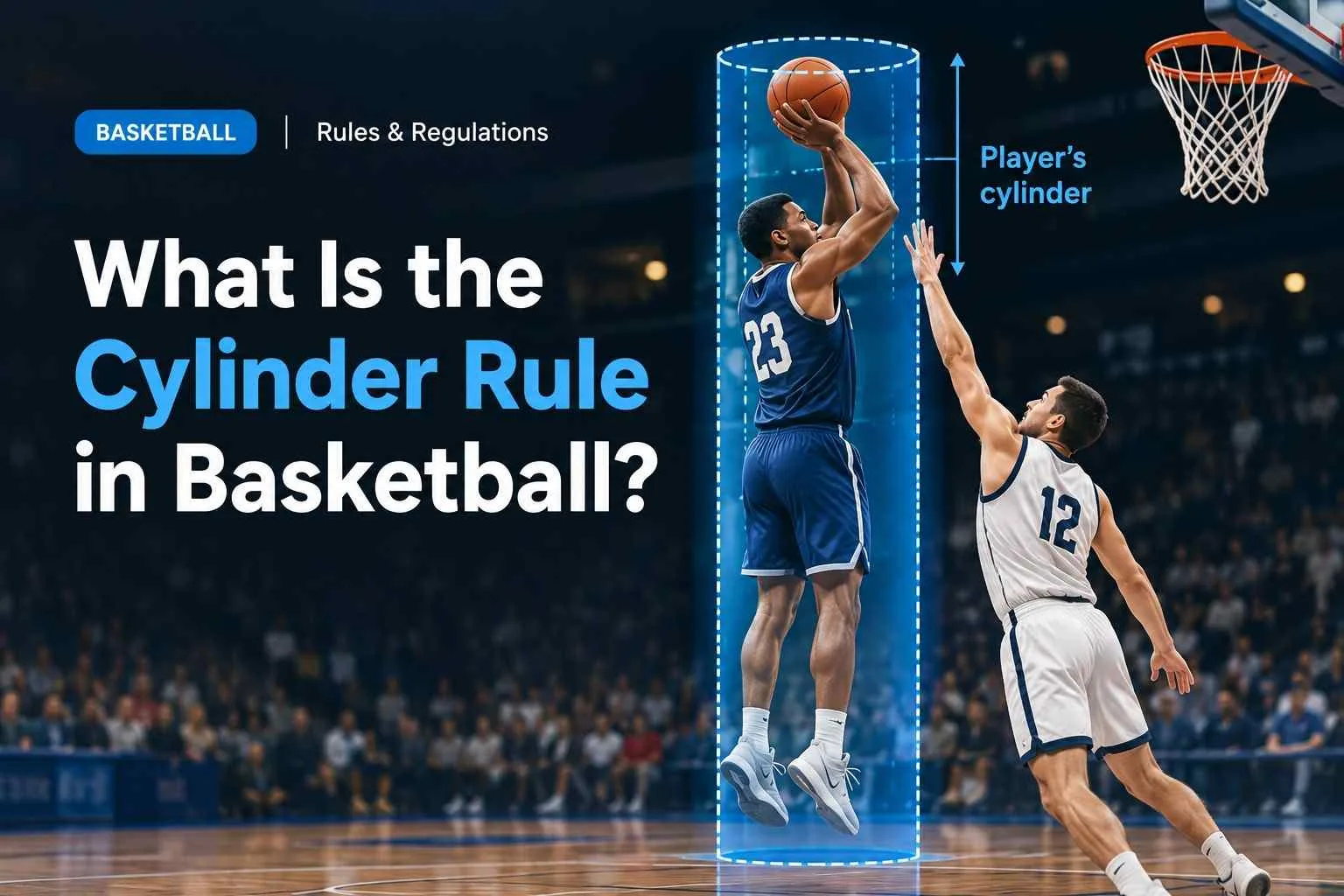
The cylinder rule gives every basketball player exclusive rights to the vertical space directly above them — an imaginary tube extending straight up from where they're standing, all the way to the ceiling. A player can jump straight up inside their own cylinder without committing a foul, even if contact happens, as long as they stay within that space.
Stepping, reaching, or leaning into another player's cylinder is what typically causes a foul to be called. FIBA officially calls this the "cylinder principle." The NBA doesn't use that exact term — it calls the same underlying concept "verticality" — but the practical idea is nearly identical in both.
1. How the Cylinder Is Actually Defined
Under FIBA's official rules, a player's cylinder has precise boundaries:
- Front: The palms of the hands, with elbows bent so the forearms and hands are raised — but no farther forward than the feet.
- Back: The buttocks.
- Sides: The outer edge of the arms and legs.
- Top: Unlimited — the cylinder extends straight up, allowing a player to jump.
A player is allowed to occupy any cylinder space that isn't already legally occupied by an opponent. Nobody else is permitted to step or reach into that space.
If a player extends their limbs or bends their body in an unnatural way to create contact, and it puts the opponent at a disadvantage, the official can call a foul.
2. FIBA's "Cylinder Principle" vs the NBA's "Verticality"
This is the exact point of confusion behind most searches on this topic. Both leagues are protecting essentially the same idea — a defender's right to their own vertical space — but they officiate and name it slightly differently:
- FIBA: Explicitly defines and names the cylinder in its rulebook, with the precise front, back, and side boundaries described above.
- The NBA: Doesn't formally use "cylinder principle" as rulebook terminology. Instead, it protects the same space under the concept of verticality.
A defender is entitled to jump straight up from a legally established position and occupy that vertical column, even if contact occurs, as long as they stay vertical and don't lean, reach, or "jackknife" into the offensive player.
In practice, both rules produce very similar outcomes on the court: a defender who jumps straight up to contest a shot is generally not called for a foul simply because contact happens, provided the defender remains within their legal vertical space.
3. The Cylinder Rule vs Goaltending: Two Different Things
These get confused constantly, but they're separate rules addressing different situations:
- Cylinder/verticality: This is about personal contact between players — whether a defender's body position was legal when contact happened.
- Goaltending (basket interference): This is about touching the ball itself near the rim — illegally blocking a shot on its way down, or touching the ball while it's above the rim inside the basket's airspace.
See the full basketball violations breakdown for how goaltending specifically works.
A defender can be perfectly legal under the cylinder/verticality rule and still commit goaltending on the same play if they touch the ball rather than just contest the shooter's body. The two situations are evaluated independently.
4. A Related Concept: The Restricted Area
Directly connected to verticality is the NBA's restricted area — a marked semicircle on the floor under the basket, sometimes called the "no-charge zone."
A secondary defender standing inside this area generally cannot draw a charging foul against a driving offensive player, unless that defender is jumping straight up and staying vertical to contest the shot.
This rule exists specifically to prevent defenders from simply standing under the basket to draw charging fouls against driving players.
FAQs
What is the cylinder rule in basketball?
It's the principle that every player has exclusive rights to the vertical space directly above them — an imaginary cylinder extending from the floor to the ceiling. A player can jump straight up within their own cylinder without fouling, even if contact happens.
Is the cylinder rule the same in the NBA and FIBA?
The underlying idea is nearly identical, but the terminology differs. FIBA explicitly names and defines it as the "cylinder principle" in its official rulebook. The NBA calls the equivalent concept "verticality" and doesn't use "cylinder" as formal rulebook language.
What counts as breaking someone's cylinder?
Stepping, reaching, or leaning into the space directly above an opponent who's already legally occupying it can constitute illegal contact. For example, a defender extending an arm forward into a shooter's vertical space rather than staying within their own column may be called for a foul.
Is the cylinder rule the same as goaltending?
No. The cylinder/verticality rule governs legal body contact between players. Goaltending is a separate rule about illegally touching the ball itself near the basket.
A play can involve one, both, or neither, depending on what actually happened.
What is the "restricted area" in basketball?
The restricted area is a marked semicircle under the basket where a secondary defender generally can't draw a charging foul against a driving offensive player, unless they're jumping straight up to contest the shot.
The rule is closely related to verticality and is designed to prevent defenders from simply positioning themselves under the rim to draw contact.
Sources & Verification
Verified against the FIBA Official Basketball Rules for the Cylinder Principle and the NBA Official Rulebook for Verticality and Restricted Area provisions.
Last reviewed: 2026-09-19 by the Laws of Sport Editorial Team.