
9 Basketball Violations Explained
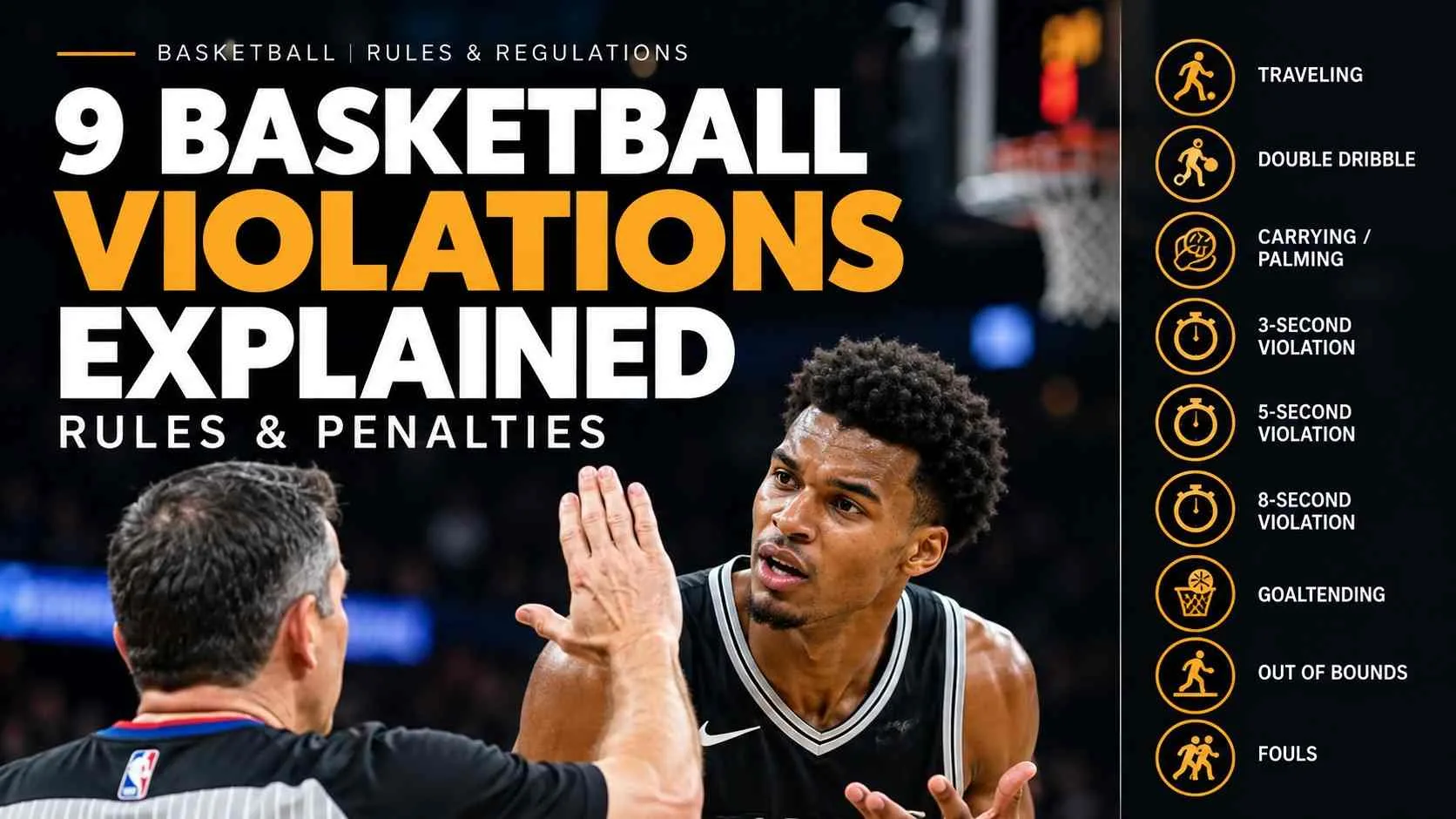
9 Basketball Violations Explained: Rules & Penalties
BASKETBALL | RULES & REGULATIONS
SOURCE: NBA Official Rulebook; FIBA Official Basketball Rules
LAST UPDATED: September 17, 2026
READ TIME: 7 min read
DIRECT ANSWER
A basketball violation is a rule break that generally results in a loss of possession but does not involve illegal physical contact. Unlike most fouls, a violation does not result in free throws. The opposing team normally receives the ball on a throw-in from the location specified by the applicable rules.
The 9 common violations covered here are traveling, double dribble, carrying, backcourt violation, offensive 3-second violation, defensive 3-second violation, 5-second closely guarded violation, 8-second backcourt violation, and goaltending/basket interference.
1. Traveling
What it is: Moving the pivot foot illegally while holding the ball without dribbling.
What happens next: The opposing team is awarded the ball for a throw-in.
Once a player stops dribbling, the applicable rules determine the player's pivot foot and permitted steps. FIBA rules specifically account for a gather step followed by permitted steps before a player passes or shoots. Differences in rule interpretation and officiating mechanics can make traveling calls a frequent source of discussion.
2. Double Dribble
What it is: Ending a dribble and then starting another dribble before the ball is passed or touched by another player.
What happens next: The opposing team receives possession through a throw-in.
After a player's dribble has ended, the player generally must pass or shoot rather than begin another dribble. Specific situations, such as a jump ball or throw-in, have separate provisions under the rules.
3. Carrying or Palming
What it is: Continuing a dribble while placing the hand underneath or otherwise allowing the ball to come to rest in the player's hand.
What happens next: The opposing team receives possession.
A legal dribble requires the ball to be continuously bounced rather than carried or allowed to rest in the player's hand. The exact terminology and enforcement can vary between rulebooks.
4. Backcourt Violation
What it is: After establishing team control in the frontcourt, the offensive team causes the ball to return illegally to its backcourt and is first to touch it there.
What happens next: The opposing team receives the ball.
The rule is designed to prevent an offensive team from deliberately returning the ball to its own half after legally establishing frontcourt control.
5. Offensive 3-Second Violation
What it is: An offensive player remains in the restricted area/free-throw lane for longer than the permitted three consecutive seconds while the team controls the ball in the frontcourt.
What happens next: The opposing team receives possession.
The three-second rule prevents offensive players from remaining continuously near the basket and gaining an unfair positional advantage.
6. Defensive 3-Second Violation
What it is: In the NBA, a defensive player remains in the lane for more than three seconds without actively guarding an opponent as required by the rule.
What happens next: Under NBA rules, the penalty is a defensive three-second technical foul, which includes one free throw and continued possession for the offensive team.
This rule is an important difference between NBA and FIBA basketball. FIBA does not have the NBA-style defensive three-second rule.
7. 5-Second Closely Guarded Violation
What it is: Under rules that use the closely guarded count, a player who is closely guarded while holding the ball must take the required action within the permitted five seconds.
Depending on the applicable rulebook, the player may need to pass, shoot, or dribble to end the count.
What happens next: The opposing team receives possession if the player violates the applicable five-second rule.
The purpose is to prevent a player from simply holding the ball indefinitely while closely guarded.
8. 8-Second Backcourt Violation
What it is: The offensive team fails to advance the ball from its backcourt into the frontcourt within eight seconds after gaining team control.
What happens next: The opposing team receives possession.
The NBA and FIBA both use an 8-second backcourt time limit, although the precise timing provisions differ according to the applicable rulebook.
9. Goaltending and Basket Interference
What it is: Goaltending generally involves illegally touching a shot while it is on its downward flight toward the basket or otherwise meets the rule's protected-shot conditions. Basket interference involves illegal contact with the ball, basket, or cylinder during a scoring attempt.
What happens next: The result depends on whether the violation is committed by the offense or defense. A defensive goaltending or basket-interference violation can result in the shooting team being credited with the appropriate basket.
These rules prevent players from illegally altering the outcome of a shot around the basket.
Violations vs. Fouls: What's the Difference?
The key difference is that a violation is generally a procedural or playing-rule infringement, while a foul involves illegal physical contact or another conduct covered by the foul rules.
| Basketball Violation | Basketball Foul |
|---|---|
| Usually a playing-rule infringement | Usually involves illegal contact or prohibited conduct |
| Generally results in loss of possession | Can result in free throws or possession |
| Examples: traveling, double dribble | Examples: personal foul, shooting foul |
| Does not normally involve physical contact | Contact is commonly involved |
The defensive three-second rule is a special NBA case because its penalty is a technical foul rather than an ordinary turnover.
Why Do Basketball Violations Matter?
Violations are designed to keep the game moving and prevent players from gaining an unfair advantage through illegal ball handling, positioning, timing, or shot interference.
Understanding these rules makes it easier to follow common calls during NBA, FIBA, college, and other basketball games.
FAQs
What is the difference between a violation and a foul in basketball?
A violation is generally a playing-rule infringement that results in a change of possession or another specified penalty. A foul involves illegal contact or prohibited conduct and can result in free throws, possession, or other penalties depending on the situation.
What is considered traveling in basketball?
Traveling occurs when a player illegally moves their feet while holding the ball without legally dribbling. The exact permitted footwork depends on the applicable basketball rulebook.
What's the difference between double dribble and carrying?
A double dribble occurs when a player ends a dribble and then begins another one illegally. Carrying occurs when the player illegally places the hand underneath the ball or allows it to rest while dribbling.
How many seconds can an offensive player stay in the paint?
Under the NBA and FIBA rules, an offensive player cannot remain in the restricted lane for more than three consecutive seconds while the team controls the ball in the frontcourt, subject to the exceptions in the applicable rulebook.
What happens on a goaltending violation?
A defensive goaltending violation can result in the shooting team being credited with the appropriate basket. The exact result depends on the circumstances and applicable rules.
How long does a team have to cross halfcourt?
Under NBA and FIBA rules, a team generally has 8 seconds to advance the ball from the backcourt to the frontcourt after gaining team control.
Sources & Verification
Verified against the NBA Official Rulebook and FIBA Official Basketball Rules.
Official references:
- NBA Official Rulebook —
https://official.nba.com/rulebook/ - FIBA Official Basketball Rules —
https://www.fiba.basketball/en/rules/official-basketball-rules
Last reviewed: 2026-09-17 by the Laws of Sport Editorial Team.