
Football vs Rugby: Every Key Difference Explained
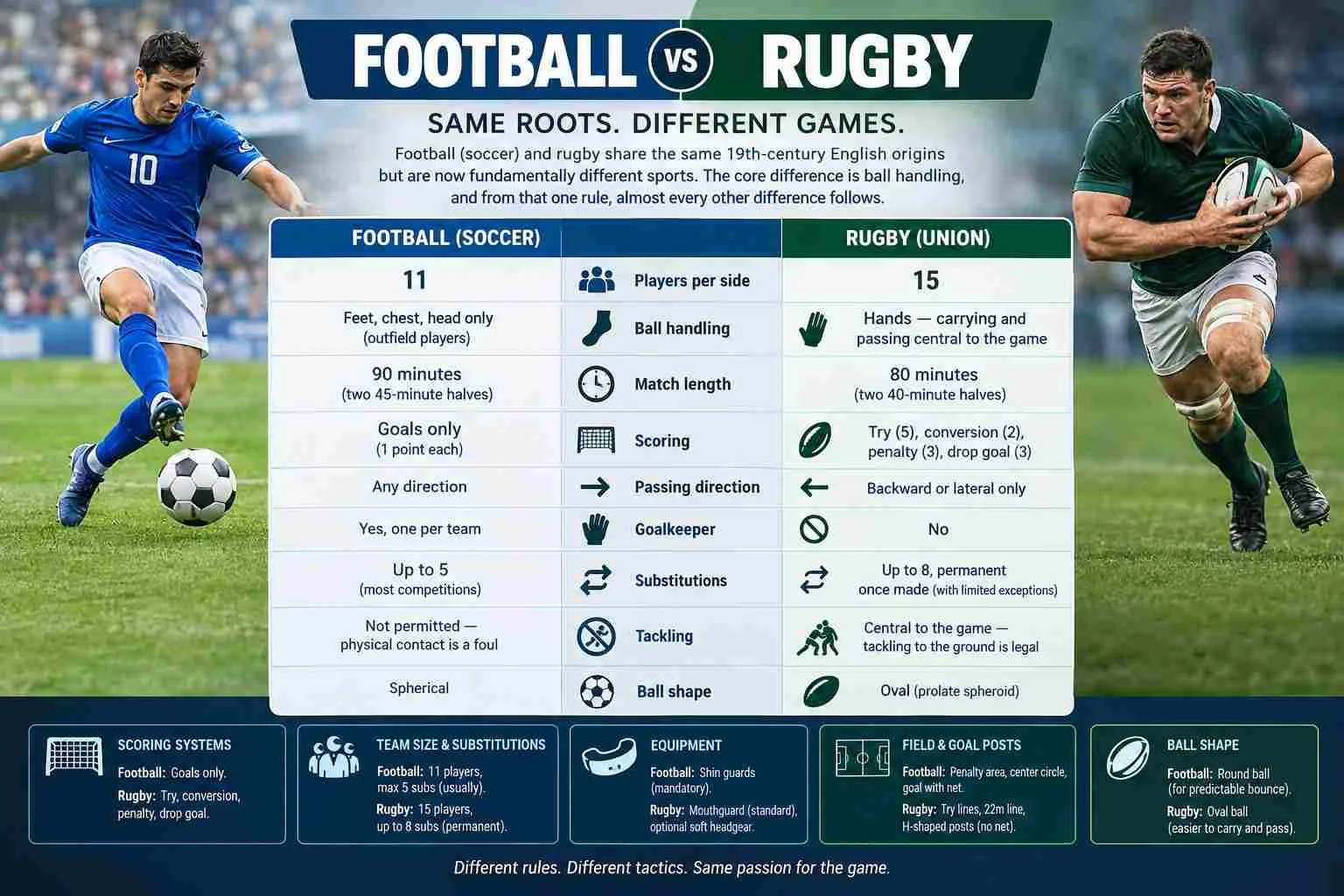
Football vs Rugby: What Is the Difference?
FOOTBALL | Comparisons
SOURCE: IFAB Laws of the Game; World Rugby Laws of the Game
LAST UPDATED: 2026-09-13
READ TIME: 8 min read
Direct Answer
Football (soccer) and rugby share the same 19th-century English origins but are now fundamentally different sports. The core difference is ball handling: football restricts outfield players to feet, chest, and head only, while rugby is built around carrying, passing, and tackling the ball by hand.
From that one rule, almost every other difference — scoring, team structure, field shape, equipment — naturally follows.
Quick Comparison Table
| Feature | Football (Soccer) | Rugby (Union) |
|---|---|---|
| Players per side | 11 | 15 |
| Ball handling | Feet, chest, head only for outfield players | Hands — carrying and passing central to the game |
| Match length | 90 minutes (two 45-minute halves) | 80 minutes (two 40-minute halves) |
| Scoring | Goals only (1 point each) | Try (5), conversion (2), penalty (3), drop goal (3) |
| Passing direction | Any direction | Backward or lateral only |
| Goalkeeper | Yes, one per team | No |
| Substitutions | Up to 5 in most competitions | Up to 8, permanent once made, with limited exceptions |
| Tackling | Not permitted — physical contact is a foul | Central to the game — tackling to the ground is legal |
| Ball shape | Spherical | Oval (prolate spheroid) |
Ball Handling: The Core Difference
Everything else in this comparison flows from one rule.
In football, only the goalkeeper may use their hands, and only inside their own penalty area. Every outfield player must control, pass, and shoot using their feet, chest, thighs, or head for the entire match.
Rugby takes the opposite approach: players are expected to catch, carry, and pass the ball by hand, and running with the ball while being tackled is the basic unit of the game.
The one restriction rugby does have is that hand passes can only go backward or sideways. A forward hand pass is an infringement, though the ball can be kicked forward freely.
Scoring Systems Compared
Football has one scoring method: get the ball fully across the goal line and between the posts, worth one goal.
Rugby has four different ways to score:
Try — 5 Points
A try is scored by grounding the ball in the opponent's in-goal area. It is rugby's equivalent of a touchdown.
Conversion — 2 Points
A conversion is a kick at goal after a try. It is taken from a spot in line with where the try was scored.
Penalty Goal — 3 Points
A penalty goal is a kick at goal awarded for a serious infringement by the opposition.
Drop Goal — 3 Points
A drop goal is scored when a player drop-kicks the ball through the posts during open play. It is worth less than a try but can be achieved at any moment in the game.
Team Size and Substitutions
Football fields 11 players per side, with a maximum of 5 substitutions in most competitions during normal time.
Rugby union fields 15 players per side. Rugby league uses 13 players. In rugby union, up to 8 substitutions are allowed.
The bigger difference is what happens after a substitution. In football, once a substituted player leaves, they generally cannot return, except in specific youth and grassroots contexts.
Rugby is broadly similar, though front-row forwards have specific medical and tactical replacement allowances due to scrum safety requirements that do not exist in football.
Tackling and Physical Contact
This is the difference most casual fans already sense intuitively.
In football, deliberately tackling or making significant physical contact with an opponent is a foul, penalized with a free kick or penalty.
In rugby, tackling the ball carrier to the ground is not just legal — it is one of the sport's central mechanics.
When a tackle is made, the ball carrier must immediately release the ball, triggering a contest for possession called a ruck, rather than play stopping the way it does in football after most physical contact.
Equipment Differences
Football players wear minimal protective equipment. Shin guards are typically mandatory.
Rugby, despite being the more physically contact-heavy sport, also uses minimal protective gear by design. A mouthguard is standard, and optional soft headgear, known as scrum caps, is permitted. Hard helmets and heavy padding are not part of the sport, unlike American football.
This surprises people who assume more contact automatically means more padding. Rugby's tackling technique is built around avoiding exactly the kind of high-speed, helmet-first collisions that heavy protective gear is designed for in other sports.
Field and Ball Shape
A football pitch and a rugby pitch are similar in overall size but marked differently.
Football uses a penalty area, center circle, and goal posts with a crossbar and net.
Rugby uses try lines, a 22-meter line, and H-shaped goal posts with no net. The ball passes over the bar, not into a net.
The ball shape is the most visually obvious difference. Football uses a spherical ball for consistent, predictable rolling and kicking, while rugby's oval ball is specifically shaped to be easier to carry and pass by hand, with an unpredictable bounce that is a deliberate, accepted part of the game.
Sources & Verification
Verified against the IFAB Laws of the Game and World Rugby's Laws of the Game.
Last reviewed: 2026-09-13 by the Laws of Sport Editorial Team.