
Who Is the Greatest Football Player of All Time? The Top 10, Ranked
FOOTBALL | Records & Legends SOURCE: Ballon d'Or official records; FIFA and UEFA competition archives | LAST UPDATED: 2026-09-04 | READ TIME: 9 min read
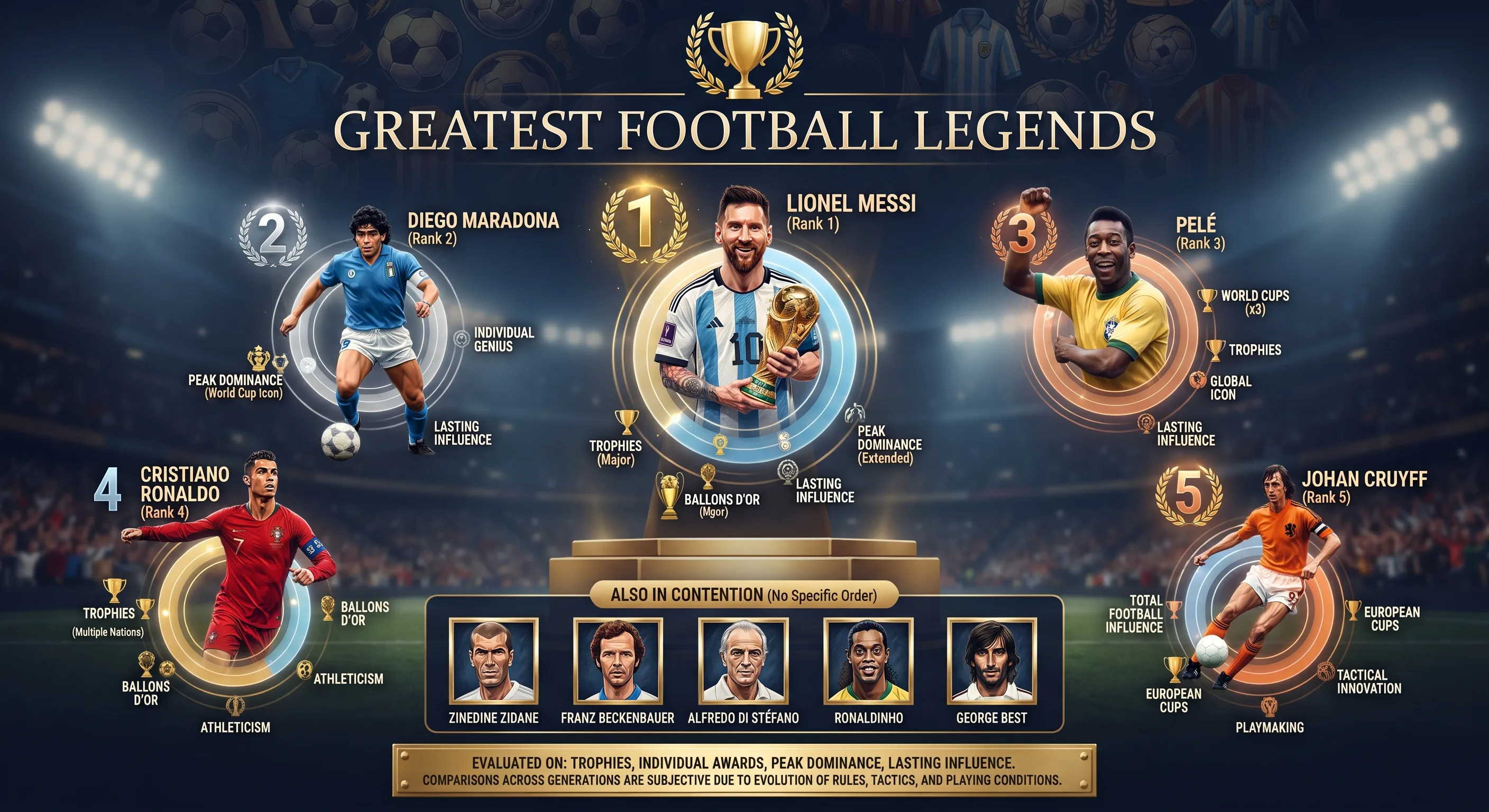
There's no single, settled answer — "greatest of all time" spans eras with different rules, competition levels, and even different balls, which makes a clean statistical comparison impossible. What follows is a reasoned ranking based on trophies, individual awards, peak dominance, and lasting influence on the sport, not a single declared winner. Most modern rankings put Lionel Messi and Diego Maradona at or near the top, followed closely by Pelé, Cristiano Ronaldo, and Johan Cruyff — but every one of these names has a real, defensible case.
How This Ranking Is Judged
Four criteria, weighted together rather than any one deciding the list on its own:
Trophies league titles, Champions League/European Cup wins, and international tournaments won
Individual recognition — Ballon d'Or wins and other major individual awards, as judged by the sport's contemporaries at the time
Peak dominance how far ahead of the competition a player was during their best years
Lasting influence whether the player changed how the position or the sport itself is played
##1.
Lionel Messi
Messi holds the record for the most Ballon d'Or wins of any player — eight, more than double the next closest competitor outside his own era. He won the 2022 World Cup with Argentina, the one major honor that had been missing from his résumé for most of his career, silencing much of the remaining debate about his international legacy. His peak years at Barcelona are widely regarded as the most statistically dominant sustained stretch by any player in the modern game, and unlike most of the players on this list, he's continued performing at a high level well past the age most elite players decline.
##
2Diego Maradona
Maradona's case rests heavily on a single tournament: the 1986 World Cup, where he single-handedly dragged an otherwise average Argentina squad to the title, including two of the most famous goals in the sport's history in the same match against England. He never had the sustained club-level trophy haul of players higher on pure numbers, but for raw individual influence on a match — the ability to change a game by himself against elite opposition — many former players and coaches from his era still rank him first, not second.
3. Pelé
The only player to win three World Cups (1958, 1962, 1970), Pelé's international scoring record and the sheer scale of his goal output across a long career at Santos remain historically unmatched by most measures, even accounting for the different competitive standards of his era. He's also the player most credited with turning football into a global spectacle beyond Europe and South America his exhibition tours with the New York Cosmos in the 1970s are often cited as a direct precursor to football's later growth as a mainstream sport in the United States.
4. Cristiano Ronaldo
Ronaldo's case is built on longevity and record-breaking output across an unusually long prime five Ballon d'Or wins, Champions League titles with two different clubs (Manchester United and Real Madrid), and a UEFA European Championship win with Portugal in 2016. He holds the record for most goals scored in the Champions League, a competition he dominated across more than a decade. Where Messi's game is built on creativity and vision, Ronaldo's case rests on being one of the most complete goal-scoring machines the sport has produced, sustained over an exceptionally long career.
5. Johan Cruyff
Cruyff won three Ballon d'Ors and was the on-field embodiment of "Total Football" — the tactical philosophy developed at Ajax and the Netherlands national team in the 1970s that still influences how positions and formations are coached and played today. His direct influence didn't stop at his playing career: as a manager at Barcelona, he laid the tactical foundation that the club (and much of possession-based football globally) still builds on today, making his impact on the sport arguably broader than any player judged purely on playing statistics.
Honorable Mentions (6–10)
Zinedine Zidane — World Cup winner (1998) and one of the most technically gifted midfielders ever, capped by his performance in the 2002 Champions League final.
Franz Beckenbauer redefined the sweeper/libero role and won the World Cup as both player (1974) and manager (1990).
Alfredo Di Stéfano the dominant figure of Real Madrid's five consecutive European Cup wins from 1956–1960.
Ronaldinho the player most credited with popularizing modern flair football globally in the mid-2000s.
George Best Northern Ireland's generational talent, whose club career at Manchester United is still cited as a benchmark for individual skill in the English game.
Related Reading
The Offside Rule Explained one of the biggest rule changes referenced in the "why there's no single GOAT" debate above
Football Positions Explained for more on the roles Cruyff, Beckenbauer, and other legends redefined
The Laws of Football: Complete IFAB Guide the current rulebook these players' eras are compared against
##FAQs
Who is officially considered the greatest football player of all time. There's no official ranking body that settles this it's a matter of ongoing debate among fans, players, and pundits. Messi and Maradona are the two names most commonly cited at the top, based on individual awards, World Cup success, and peak dominance.
Is Messi or Ronaldo the greatest of all time? Both have a genuine case. Messi has more Ballon d'Or wins and is generally seen as the more creative, vision-driven player; Ronaldo has a longer sustained scoring peak and more varied trophies across different clubs and countries. Most rankings put them 1st and 2nd or 2nd and 3rd, depending on which criteria are weighted more heavily.
How many Ballon d'Or awards does Messi have? Eight the most of any player in the award's history, more than double Ronaldo's total of five, which is the second-highest.
Did Pelé play against modern-level competition? This is one of the biggest points of debate in GOAT discussions. Pelé's era had less global depth of competition than today's game, which is why some rankings place him below Messi or Maradona but his three World Cup wins and historic scoring record remain factually unmatched regardless of the competition level debate.
Why isn't there one agreed-upon "best player ever"? Because football has changed too much across eras to compare fairly different rules (like the offside law changes), different physical demands, different levels of global competition, and even different equipment make a clean statistical comparison across generations effectively impossible.
Sources & Verification
Verified against official Ballon d'Or, FIFA, and UEFA competition records for trophy and award counts. Last reviewed: 2026-09-04 by the Laws of Sport Editorial Team. Player achievements current as of publication some totals (career goals, active trophies) will change as players currently still competing continue their careers.