
Tennis Net Height Rules: Center vs. Posts, Explained
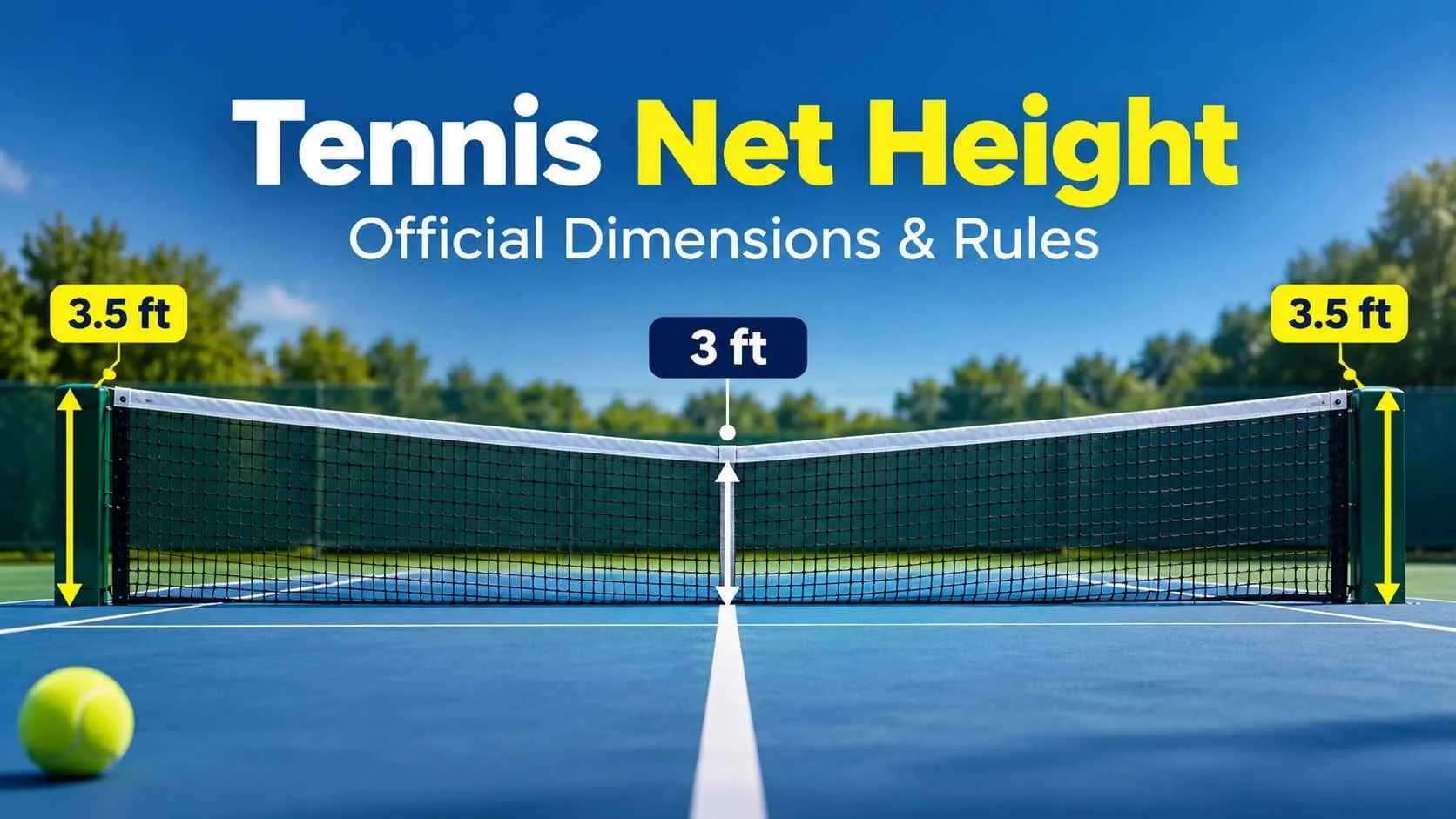
Tennis Net Height: Official Dimensions & Rules
TENNIS | Rules & Regulations
SOURCE: ITF Rules of Tennis, Rule 1 (The Court) | LAST UPDATED: 2026-09-28 | READ TIME: 4 min read
DIRECT ANSWER
A regulation tennis net is 3 feet (0.914 m) high at the center and 3.5 feet (1.07 m) high at the posts, under ITF Rule 1. This applies to both singles and doubles — the difference between the two formats is where the net posts are placed, not how high the net is.
For more official tennis rules and regulations, see our Tennis Rules & Regulations guide.
1. Why the Center Is Lower Than the Posts
What it is: The net is suspended between two posts at 3.5 feet, then pulled down and held taut at the center by a white strap, which brings the middle down to exactly 3 feet.
Why it matters: This half-foot dip in the middle is deliberate, not sag from wear. It slightly favors shots hit down the center of the court over shots aimed at the sidelines — which is one reason cross-court shots are generally considered a safer, higher-percentage option than shots hit down the line.
2. Where the Net Posts Actually Go
Doubles: The center of each net post sits 3 feet outside the doubles sideline on each side.
Singles: If a dedicated singles net is used, the posts sit 3 feet outside the singles sideline instead — closer together than the doubles posts.
Why it matters: Because doubles courts are wider than singles courts, a net designed for doubles (and its posts) can't simply be reused for singles without adjustment — the posts are in the wrong place for a singles-width net to hang correctly.
3. What Singles Sticks Are For
The problem: Most public and club courts have only one set of net posts, positioned for doubles. Using that same net for a singles match would leave gaps of open space beyond each singles sideline where the net isn't properly supported.
The fix: Two portable poles, called singles sticks, are placed 3 feet outside the singles sidelines and prop the doubles net up to the correct 3.5-foot height at those points — without needing separate net posts or a separate net. The ITF rule caps singles sticks at no more than 3 inches in diameter.
4. Net Height for Junior and Adjusted Formats
What it is: Junior competition formats built around shorter, slower-paced play use lower nets to match a smaller court. The most common youth progression, often called the Red, Orange, and Green stages, uses nets and courts scaled down from the full adult size.
Why it matters: This keeps rallies within reach for younger or newer players — a full 3.5-foot net on a full-size court makes the game significantly harder to sustain a rally on, which is part of why youth pathways almost always start smaller.
5. The Other Net Specifications the Rule Covers
What it is: Beyond height, ITF Rule 1 also specifies that the net must be filled completely between the posts with no gaps, made of mesh small enough that a ball can't pass through, and topped with a white band between 2 and 2.5 inches deep.
Why it matters: These details exist so that a shot which clips the very top of the net is judged consistently at every sanctioned court in the world — the same reasoning covered on this site's let-rule explainer, since a ball touching that white band on a serve is exactly what triggers a let.
Related Reading
- Tennis Scoring Explained
- What Is a Let in Tennis? The Serve Rule Explained
- The First Wimbledon Championship: Spencer Gore and the Birth of Tennis, 1877
Sources & Verification
Verified against the ITF Rules of Tennis, Rule 1 (The Court), official specification text.
Last reviewed: 2026-09-28 by the Laws of Sport Editorial Team.